
Business
The Siege on OML 42: Inside the Suspicious Legal Frenzy Targeting Nestoil and Neconde

The Siege on OML 42: Inside the Suspicious Legal Frenzy Targeting Nestoil and Neconde
Ex parte orders freeze billions in assets as oil firms fight to protect operations
A high-stakes battle threatening to upend Nigeria’s indigenous oil industry
On quiet days, OML 42 sleeps like a wounded giant in the swamps of the Niger Delta—its pipelines humming with the fading memory of roaring production, politics, and crude oil fortunes. But in recent weeks, the oilfield has become the epicentre of a legal hurricane so violent that it has shaken boardrooms from Lagos to London and rattled investor confidence in Nigeria’s fragile petroleum economy.
At the heart of the crisis sit Nestoil Limited, Neconde Energy, and an explosive mix of lenders, judges, regulators, lawyers, and petitioners—each tugging at an oil asset that once fed the national treasury with imperial abundance. What began as a routine debt-recovery move has spiralled into a sprawling legal war, punctuated by allegations of judicial overreach, suppressed facts, corporate asphyxiation, and fears of an orchestrated attempt to seize control of OML 42 through the courts.
What follows is the inside story of how sweeping ex parte orders froze billion-dollar assets, halted oil production, provoked foreign lenders, triggered judicial petitions, and raised the spectre of a catastrophic collapse with implications far beyond any courtroom.
—
A Single Order That Shook the Oil Sector
It began quietly on October 20, 2025, when FBNQuest Merchant Bank and First Trustees filed an ex parte motion. By October 22, Justice Dehinde Dipeolu of the Federal High Court, Lagos, had granted one of the broadest Mareva injunctions in recent Nigerian corporate history.
The order froze all bank accounts, shares, and assets of Nestoil, Neconde, and related companies—effectively paralysing a multi-billion-dollar group with strategic footprints in engineering, oil services, and upstream petroleum.
The plaintiffs claimed the companies owed $1.01 billion and ₦430 billion. The defendants said the figures were unverified, inflated, and grossly misleading.
Yet without hearing from the companies, the court ordered a blanket freeze, sweeping through commercial banks like a harmattan storm and locking out executives and signatories overnight.
Even more controversially, the ex parte order empowered a receiver/manager, and allegedly authorised the Nigerian Navy and DSS to enforce the civil directives—a move critics say militarises what is essentially a commercial dispute.
For Neconde, operator of OML 42 with roughly 40,000 barrels per day, the effect was devastating:
production collapsed to zero.
—
Neconde: “We Do Not Owe a Kobo.”
Shocked by the freeze, Neconde insisted it is not indebted under the syndicated loan that forms the basis of the plaintiffs’ claims:
It was neither borrower nor guarantor.
It already has an active winding-up proceeding (FHC/CP/1439/2025), which under CAMA 2020 protects it from fresh lawsuits or enforcement without leave of court.
Any order against it, therefore, is “null, void, and of no effect.”
Neconde accused the plaintiffs of:
Dragging it into a dispute that doesn’t concern it
Judicial overreach
Wrongful interference with third-party rights
Causing the shutdown of an oilfield critical to national revenue
—
Foreign Lenders Enter the Battlefield
The crisis escalated dramatically when foreign lenders stormed the courtroom.
Glencore Energy UK Limited, Fidelity Bank, Mauritius Commercial Bank, and the Africa Finance Corporation—senior creditors behind a $640 million syndicated facility—warned that Justice Dipeolu’s orders threaten the very foundation of international financing for Nigeria’s indigenous oil sector.
Represented by Olufemi Oyewole, SAN, they argued:
The plaintiffs obtained the injunction by concealing the existence of the senior secured loan.
The Deed of Charge relied upon by the plaintiffs is subordinate to the lenders’ security documents.
Freezing Neconde’s accounts jeopardises repayment of their facility.
Nigeria risks massive reputational damage if court orders can override established security hierarchies.
Their intervention reframed the matter as a test of whether Nigeria is still a safe jurisdiction for international oil financing.
—
Petitions to the Chief Judge—and an Embattled Judiciary
Then came the most explosive turn.
Petitions flooded the office of the Chief Judge of the Federal High Court and the National Judicial Council, accusing Justice Dipeolu of judicial excess. Among the allegations:
Issuing sweeping orders over assets whose ownership was unclear
Involving military agencies (Navy and DSS) in enforcement of civil orders
Freezing assets of Neconde despite ongoing winding-up proceedings
Allowing crude sales under a receivership arrangement in violation of the preservative nature of interim injunctions
On November 7, Justice Dipeolu admitted receiving the petitions and suspended further proceedings pending the Chief Judge’s directive on whether he should continue or recuse himself.
What started as routine debt recovery had now grown into an institutional crisis threatening judicial credibility.
—
Nestoil and Neconde Fight Back
The companies responded with a strong counteroffensive.
They accused the plaintiffs of suppressing a critical fact:
a Common Terms Agreement executed in December 2022, under which the alleged debts were restructured with a fresh 10-year repayment plan.
Other key defence arguments:
FBNQuest allegedly refused to provide account statements for over three years, making the debt unverifiable.
The receiver appointed by the plaintiffs is allegedly not registered with the Corporate Affairs Commission, contrary to CAMA.
The sweeping order froze personal accounts of directors—an act they call illegal and vindictive.
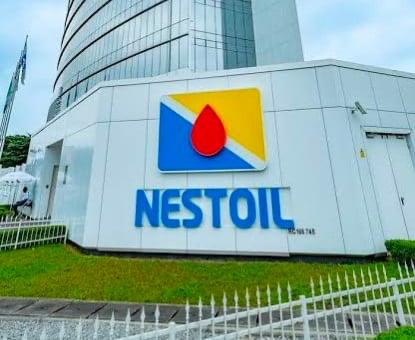
Nestoil Tower, an iconic, immovable property in Victoria Island, was frozen unnecessarily, suggesting an attempt at strategic seizure.
The companies warned that the consequences of these actions are fatal:
OML 42 shutdown
Collapse of corporate operations
Interruption of contractual obligations with the Federal Government
Severe revenue losses to Nigeria
—
A Dark Suspicion: Is Someone Trying to Seize OML 42?
In industry circles, a troubling theory has taken root:
that the entire legal drama may be a covert corporate raid designed to take over OML 42 through judicial means.
Fueling this suspicion:
The breadth of the ex parte orders
Attempted crude-sale authorisations
Military involvement
Disregard of winding-up protections
A sweeping receivership with overreaching powers
Complete paralysis of accounts and operations
Nigeria has seen similar corporate warfare before—where interim injunctions were weaponised for strategic acquisition. Whether true or not, the speculation reflects the deep mistrust that shadows high-value commercial disputes in the country.
—
Why This Matters for Nigeria
OML 42 is not an ordinary asset.
In the 1970s, it produced nearly 250,000 barrels per day—one of Nigeria’s crown jewels.
Today, Nigeria’s struggling oil industry faces:
declining production
massive divestments
chronic vandalism
evaporating investment
A prolonged shutdown of OML 42 would be catastrophic.
Foreign lenders are watching. International oil financiers are watching. Indigenous operators are watching.
If a single ex parte order—delivered without hearing from affected companies—can halt a producing oilfield overnight, the message to global capital is chilling.
—
A Nation on the Edge of a Precedent
The case now sits in a tense limbo, awaiting the Chief Judge’s directive on whether Justice Dipeolu will continue or step aside.
What happens next is critical.
For Nestoil and Neconde, it is a fight for survival.
For senior lenders, it is a defence of global financing principles.
For the judiciary, it is a test of integrity and restraint.
For Nigeria, it is a moment of reckoning.
Will the rule of law steady the ship—or will this become another cautionary tale in Nigeria’s turbulent oil industry?
For now, OML 42 lies quiet, its wells dormant, its pipelines still, a sleeping colossus held hostage by the uncertain rhythms of law, power, and ambition.





Fidelity Bank grows gross earnings by 38% to N434.95b in Q1
Fidelity Bank Plc recorded 37.9 per cent growth in gross earnings to N434.95 billion in first quarter 2026 as the international commercial bank continued to expand its core banking market share.
Interim report and accounts of Fidelity Bank for the three months ended March 31, 2026 released at the Nigerian Exchange (NGX) showed that gross earnings rose from N315.42 billion in first quarter 20025 to N434.95 billion in first quarter 2026, representing an increase of 37.9 per cent.
The top-line performance was driven by impressive growth in the bank’s core business operations with interest incomes rising by 22.8 per cent to N314.48 billion in first quarter 2026 as against N256.10 billion in first quarter 2025.
With net interest income at N180.97 billion, the bank closed the period with profit before tax of N92.48 billion. After taxes, net profit stood at N74.47 billion for the three-month period. Earnings per share remained high at N5.69, underlining the capacity of the bank to reward its shareholders.
The balance sheet of the bank also emerged stronger. Total assets crossed the N11 trillion mark to N11.35 trillion by March 2026 compared with N10.46 trillion recorded in December 2025. Customers’ deposits increased from N6.89 trillion to N7.38 trillion. Total equity rode on the back of earnings growth to a 27.5 per cent increase from N1.09 trillion in December 2025 to N1.39 trillion by March 2026.
The first quarter 2026 results further consolidated the strong earnings outlook of the bank, which had successfully completed its recapitalisation amidst impressive earnings performance in 2025.
Fidelity Bank had recorded double-digit growths in interest and non-interest incomes as well as key balance sheet items during the year ended December 31, 2025.
The audited report showed that gross earnings rose from N1.04 trillion in 2024 to N1.52 trillion in 2025, an increase of 45.6 per cent. Interest and similar incomes had grown by 38.7 per cent from N803.1 billion in 2024 to N1.11 trillion in 2025. Fees and commission incomes also rose by 44.7 per cent from N78.4 billion to N113.4 billion. The bank recorded net profit after tax of N242.4 billion in 2025.
The bank’s balance sheet emerged stronger with total assets rising by 18.6 per cent to N10.46 trillion in 2025 as against N8.82 trillion in 2024. Customer deposits increased by 16.1 per cent from N5.94 trillion to N6.89 trillion, reflecting continued franchise strength and an improved funding profile. Net loans and advances meanwhile declined by 2.4 per cent to N4.28 trillion in 2025 as against N4.39 trillion in 2024, attributable to customers paying down on their mature obligations.
The bank had in 2025 strengthened its capital position, with eligible capital rising to N561 billion, above the regulatory minimum of N500 billion for banks with international authorisation. In addition, capital adequacy had remained robust, with Capital Adequacy Ratio of 30.94 per cent by December 2025 as against 23.47 per cent by December 2024.
Managing Director, Fidelity Bank Plc, Dr. Nneka Onyeali-Ikpe, said the first quarter 2026 results reinforced the bank’s strong and resilient business model.
She noted that with the remarkable success of its recapitalisation programme and continuing expansion, Fidelity Bank has entered a new era of growth and impressive returns.
“We are on a stronger footing and confident that we will set new growth records that are reflective of our legacy and the future we are working on,” Onyeali-Ikpe said.
Business
Dangote Refinery Ends Nigeria’s Era of Fuel Import Dependence, Boosts GDP, FX Earnings — EIU
Dangote Refinery Ends Nigeria’s Era of Fuel Import Dependence, Boosts GDP, FX Earnings — EIU
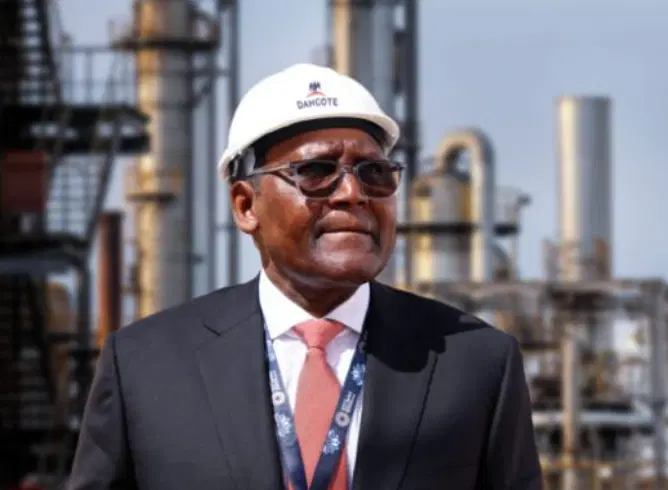
The operational ramp up of the 650,000 barrels per day Dangote Petroleum Refinery & Petrochemicals is fundamentally reshaping Nigeria’s downstream oil sector, significantly reducing the country’s dependence on imported refined petroleum products and strengthening its external position, according to the Economist Intelligence Unit (EIU).
In its latest assessment on Nigeria’s fuel market and regulatory environment, the EIU said the refinery has already transformed a sector that was previously characterised by heavy reliance on imported fuel despite Nigeria being Africa’s largest crude oil producer. The report noted that the refinery met nearly 80 per cent of domestic petrol demand in April and produced enough volumes to satisfy local consumption requirements as operations approached full capacity.
The EIU described Nigeria’s downstream petroleum sector before the refinery as “long dysfunctional”, noting that the country had remained almost entirely dependent on costly imported fuel while producing nearly 1.5 million barrels of crude oil daily.
According to the report, the emergence of the refinery has reduced import dependence, improved domestic fuel availability and strengthened Nigeria’s balance of payments position through lower import demand and rising exports of refined petroleum products.
“The gradual ramp up of the 650,000 barrel/day Dangote refinery since May 2023 has transformed Nigeria’s long dysfunctional downstream sector,” the report stated. “The country’s main refineries, all state owned, had been inoperative for years and Nigeria was almost entirely reliant on costly imported fuel.”
The research and analysis division of The Economist Group, London added that the refinery’s attainment of full operational capacity and its planned expansion would further support Nigeria’s economic growth and foreign exchange earnings over the medium term.
“Meanwhile, the attainment of full capacity at, and an increase in exports from, the Dangote refinery will support real GDP growth and foreign exchange earnings in 2026 and 2027 and beyond, as a planned doubling of the plant’s output comes on stream around the end of the decade,” it added.
Industry analysts said the refinery is increasingly positioning Nigeria as an emerging refining and export hub, altering energy trade flows across Africa and reducing the vulnerability associated with fuel import dependence.
The EIU noted that the refinery’s expansion has coincided with major reforms in Nigeria’s downstream sector, including the removal of fuel subsidies and the introduction of market driven pricing mechanisms.
The report, however, said the transition from a state dominated fuel import structure to large scale domestic refining has triggered resistance from interests linked to the old import regime.
The latest tensions emerged following the decision by the Nigerian Midstream and Downstream Petroleum Regulatory Authority to relax restrictions on petrol imports despite the refinery’s growing capacity to meet domestic demand.
Dangote Industries subsequently initiated legal action, arguing that continued import approvals undermine domestic refining investments and conflict with the objectives of the Petroleum Industry Act, which seeks to encourage local refining capacity and reduce import dependence.
Analysts noted that the availability of large-scale domestic refining capacity has improved Nigeria’s energy security and reduced exposure to external supply shocks and foreign exchange volatility.
The Centre for the Promotion of Private Enterprise also cautioned against unrestrained importation of petroleum products, warning that such a policy could weaken Nigeria’s industrialisation drive and discourage investments in domestic refining.
Chief Executive Officer of CPPE, Muda Yusuf, said continued dependence on imported fuel had historically contributed to pressure on foreign reserves, exchange rate instability and fiscal leakages.
The refinery’s growing impact is also being reflected in Nigeria’s broader macroeconomic indicators. Earlier this month, S&P Global Ratings cited increased domestic refining capacity and rising hydrocarbon exports among the major factors supporting Nigeria’s sovereign credit rating upgrade – the first in 14 years.
Beyond Nigeria, analysts said the refinery is increasingly being viewed as a strategic industrial asset for Africa, where many countries remain heavily dependent on imported fuel despite rising demand for transportation, manufacturing, and power generation.
Business
BREAKING: Court Dismisses $19.6 Million Claim Against NNPCL — Rules Contract Scope Cannot Be Changed Orally
BREAKING: Court Dismisses $19.6 Million Claim Against NNPCL — Rules Contract Scope Cannot Be Changed Orally
In a landmark ruling on Friday, May 22, 2026, the Federal Capital Territory High Court in Abuja threw out a $19.6 million lawsuit filed by Alternate Dimensions Ventures Ltd against the Nigerian National Petroleum Company Limited (NNPCL), affirming a key legal principle: a written contract cannot be expanded through oral agreements or conduct.
Alternate Dimensions had sought $19,600,000 in professional fees, claiming the scope of its Direct Sale, Direct Purchase (DSDP e-pro) contract with NNPCL was orally expanded. Represented by counsel Patrick Peter, the firm argued it was entitled to the revised sum for services rendered under the alleged new terms.
But NNPCL, through its lawyer Ituah Imhanze of KENNA LP, pushed back sharply, arguing that parties are bound exclusively by the clear terms of their written agreement. Imhanze contended that without any written amendment, the claim was legally unsound, and the court agreed.
Delivering judgment, Justice Hamza Mu’azu upheld NNPCL’s defense, stating that the contract was unambiguous and that no evidence was adduced during the trial, which supported the alleged scope expansion. The court further found that NNPCL fully complied with all contractual terms and committed no breach.
Dismissing the suit as meritless, Justice Mu’azu reinforced the doctrine of sanctity of contract: any amendment to a written agreement must be express, unequivocal, and documented, not implied or verbal.
The ruling spares NNPCL from the S19.6 million claim and also a floodgate of similar potential liabilities.


- Afreximbank Deepens Commitment to Economic Progress in The Bahamas June 1, 2026
- African Electric Vehicle (EV) platform Spiro raises $215M in equity to scale electric mobility and energy infrastructure across Africa June 1, 2026
- Africa Centres for Disease Control and Prevention (Africa CDC) Statement on Attacks Against Health Facilities During the Bundibugyo Virus Disease Response in the Democratic Republic of the Congo June 1, 2026
- Putting consumers at the centre of Africa’s dairy transformation June 1, 2026
- International Rescue Committee (IRC) warns Democratic Republic of the Congo (DRC) Ebola outbreak likely far larger than official figures suggest June 1, 2026
- South Africa: Portfolio Committee on Health Marks National Cancer Survivor Day and Reaffirms Importance of Early Detection and Public Awareness June 1, 2026
- Rwanda’s RSSB Tigers Crowned 2026 Basketball Africa League Champions June 1, 2026
- Uganda: Appointments Committee Begins Vetting of Ministerial Nominees June 1, 2026
- Sudan braces for worsening child malnutrition as pre-harvest season starts June 1, 2026
- Etu Energias Strengthens Angolan Footprint, Returns to Angola Oil & Gas (AOG) 2026 as Champion Sponsor June 1, 2026
- Afreximbank Deepens Commitment to Economic Progress in The Bahamas June 1, 2026
- African Electric Vehicle (EV) platform Spiro raises $215M in equity to scale electric mobility and energy infrastructure across Africa June 1, 2026
- Africa Centres for Disease Control and Prevention (Africa CDC) Statement on Attacks Against Health Facilities During the Bundibugyo Virus Disease Response in the Democratic Republic of the Congo June 1, 2026
- Putting consumers at the centre of Africa’s dairy transformation June 1, 2026
- International Rescue Committee (IRC) warns Democratic Republic of the Congo (DRC) Ebola outbreak likely far larger than official figures suggest June 1, 2026
- South Africa: Portfolio Committee on Health Marks National Cancer Survivor Day and Reaffirms Importance of Early Detection and Public Awareness June 1, 2026
- Rwanda’s RSSB Tigers Crowned 2026 Basketball Africa League Champions June 1, 2026
-

 news6 months ago
WHO REALLY OWNS MONIEPOINT? The $290 Million Deal That Sold Nigeria’s Top Fintech to Foreign Interests
-

 society4 weeks ago
SOCIAL MEDIA IS NOT A BATTLEFIELD COMMAND – WHY THE NIGERIAN ARMY’S ACTION AGAINST JUSTICE CRACK IS A NATIONAL SECURITY IMPERATIVE
-

 celebrity radar - gossips4 months ago
Dr. Chris Okafor Returns with Power and Fire of the Spirit -Mounts Grace Nation Altar with Fresh Anointing and Restoration Grace on February 1, 2026
-

 celebrity radar - gossips6 months ago
Prophet Kingsley Aitafo Releases 2026 Prophecy: ‘Nigeria Will Rise, but the World Must Prepare for Turbulence’